The Aaron E. Henry Community Health Services Center operates demand response transit service in the Mississippi Delta region with 45 vehicles. The city of Gadsden, Alabama runs buses on four fixed routes, but not on weekends or after 3 P.M. The Chicago Transit Authority runs some of its heavy rail lines with no worse than 15-minute frequency, all day and night, on weekdays, weekends, and holidays. All three agencies operate what the federal government characterizes as public transit service, but they differ greatly in what roles they can play in the lives of the people that they serve.
A political leader or transit advocate in Gadsden, who wants public transit to fulfill more of the needs of the city’s residents, could take cues from places like Chicago where transit has a larger role. Obviously this person will need to press for increased funding, but if they get it, spending it wisely presents its own challenges. They run the risk of fixating on the conspicuous elements of transit service, like vehicle types and infrastructure, rather than fundamental ones: what the transit service in these places aims to accomplish and what planning methodologies further these aims. A public transit hierarchy of needs could focus thought and discussion on these meaningful elements by guiding transit stakeholders through the process of understanding what their region’s transit is accomplishing now, what it could do next to meet additional needs, and what shifts in mindset would allow it to get there.
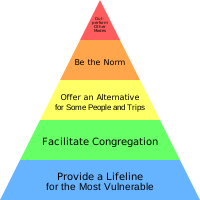
Each level of the hierarchy presents a mission, with associated planning and service assessment choices. Transit service does not just hit a specific level, but accomplishes the level’s mission, and those of the levels below, with some degree of success. Hypothetically, service can rise to any level anywhere, though demographic and land use patterns influence the cost.
The level that public transit reaches is a property of a region, rather than a transit agency. Multiple transit agencies may combine to determine which level an area reaches, and a single agency may contribute to different levels within sub-regions of its whole service area. Even a single rail or bus line may fulfill different needs along its route. The collective actions of agencies, coordinated or not, establish a region’s level.
Achieving excellence within a level does not automatically promote a region to the next one, nor does jumping to the next level mean abandoning the missions of the ones below. Instead, a jump to a new level often involves an increase in funding, shrinking the region served by transit, or more efficiently accomplishing the missions of the levels below. As importantly, it requires a shift in mindset about the role of public transit service, and the methodology underlying its planning, for those who administer, fund, and advocate for it.
A hierarchy implies a rigid and prescriptive approach to transit planning that conflicts with some prevailing views. Jarrett Walker’s Human Transit, for example, puts forth a more flexible approach to what needs transit can meet, without predetermined, successive objectives. Agencies solicit community priorities, and structure discussions of implementing them using four tradeoffs, to keep conversations from fixating on conspicuous, but secondary, details. When gathering input, though, suggestions will more often concern improvements to the ways one already uses transit, than ways transit can fulfill currently unmet needs. Consequently, this approach is more likely to reinforce whatever the transit agency is already doing than discover a uniquely community-specific mission. The hierarchy of needs has the same goal of focusing discussion, but takes a top-down approach rather than the bottom-up one that starts from community input. The missions entailed by the levels of the hierarchy of needs are generic rather than community-specific, and are imposed rather than agreed upon. Decisions about public transit service still consider community input, but the hierarchy of needs constrains conversation to the allocation of resources between growing within a level versus taking on a new mission. While this may seem constricting, it compels community members to look beyond what their transit service currently does for them, while an open solicitation of priorities does not.
Based on my observations of transit service, mostly in the United States, I propose a five-level hierarchy. Each of the next five sections discusses a level, from most widely achieved to least.
Provide a Lifeline for the Most Vulnerable
The most basic level of transit service connects people who cannot operate a car, due to age or disability, to essential services. Typically, service takes the form of a demand response system that explicitly schedules rides between origins and destinations at specific times, rather than vehicles running fixed routes. This level of service exists in many places that most people would describe as having no public transit service at all. In spite of its invisibility, lifeline service is widespread. According to a Federal Transit Administration report, 43% of transit agencies reporting data to the National Transit Database only run demand response service, and at least 84% have some demand response component. While providing a lifeline is not the only need that demand response service can meet, the report indicates this is its role in most cases.
Facilitate Congregation
In the context of public transit, the most familiar example of congregation is the commute. Many people pack into, and disperse from, city centers that are dense with jobs, at roughly the same time. Other types of trips follow this pattern, with some variations: the destination may be a university campus or suburban office park, the commuters could be students, or the occasion may be a popular sporting event. When people congregate, public transit alleviates congestion on roads and reduces the need for parking. Transit service that facilitates congregation consists of fixed routes with trips at the predictable times that congregation will occur, between obvious origins and destinations.
The process of reaching this level exemplifies how growth within a level, and reaching a new one, necessitate different actions. For a transit agency to get better at providing a lifeline, it hires more drivers and acquires more of the same small vehicles. This strategy does nothing to facilitate congregation, because it puts a vehicle on the road for every trip. Facilitating congregation requires investing in large vehicles, hiring specialized operators for them, and planning routes between outlying residential areas and hubs for them to travel along. A government may create an entirely new agency to oversee its implementation, rather than fold it into the existing provider of lifeline service. No matter how implementation happens, decision makers expand the purpose of public transit by adding service that does not conform to the existing pattern.
Offer an Alternative for Some People and Trips
At this level, some people can live car-free, using public transit to get to necessary destinations. Most people do not, as their access to desired destinations would be unacceptably diminished, but consider public transit for some trips. This level has incremental congestion-reducing benefits, but also relieves some individuals, ideally those already financially burdened, from the high costs of car ownership.
Reaching this level might seem like an incremental extension of facilitating congregation, but like any level jump, it is not. Most transit routes in networks at this level run throughout most of the day with regular frequency, but just making these alterations to existing routes does not accomplish the level’s mission. This level requires departing from the hub-and-spoke pattern of the previous level, and building an interconnected transit network.
Measuring time-bounded, population-weighted access to destinations guides the construction of transit networks at this level. Such measurements answer the question: for important destinations, and times of day when people tend to access them, how many people, when starting at their homes, can reach them in a reasonable amount of time, using any combination of walking and transit? There may be additional weight given to areas where people who are more likely to need transit service live. Changing the network’s routes to improve access to destinations constitutes growth within the level.
Planning networks at this level prioritizes equity and efficiency. Allocating service where disadvantaged people live not only attempts to mitigate historic wrongs, but supplies transit service to people who are less likely to afford a car. Densely populated areas will typically generate more riders than sparsely populated ones. This level does not strive to serve everyone, or reach everything that anyone would desire. As such, transit coexists with privately owned vehicles, which get used for the majority of trips.
Be the Norm
Transit service at this level attempts to end the primacy of the car in transportation, because any amount of car ownership hurts all transit riders. People living in transit-deprived areas still bring their cars into areas where transit service is strong, and most transit works worse when the roads are clogged with these cars. Car ownership even hinders grade-separated transit infrastructure, which ostensibly operates at a remove from existing congestion. When most people use cars, any transit infrastructure project will suffer from concessions to drivers. Designers may shift stations to suboptimal locations, or rule out certain building techniques, to reduce the impact that construction will have on drivers. Until a preference for public transit is a majority position, it will suffer under majority rule. For most people to consider public transit as the normal way of getting around, in a society where most people have already experienced, or yearn for, the freedom of car ownership, individuals must not feel like they are missing out on any opportunities that their region offers to drivers.
Ensuring that most people will not feel deprived presents an uncomfortable proposition for planners: stepping back from efficiency and equity, and running high quality transit service in areas whose residents have not yet shown an inclination to use it. An often-empty bus running through a wealthy neighborhood at 4 a.m. has value because it enables a transit trip that someone could make with a car. Time-bounded access continues to guide the design of networks, but this level’s measurement removes weighting from origins, destinations, and times of day altogether. This unweighted measurement assesses the network in terms of how well it replicates the freedom available to drivers: being able to start at any point and reach any other one, at any time of day. When public transit can provide an adequate facsimile of this, it can be the norm for getting around a region. It may not be the fastest option for every single trip, but it competes well enough that a majority of people reject the added expense of other options.
Outperform Other Modes
At this level, public transit is better than any other way of getting around, across a broad spectrum of trips. There are cases where the shared nature of public transit rules it out—a drummer going to play a show at a bar cannot realistically load their drum set onto a bus without delaying everyone else’s ride—but for most trips, transit is as fast, safe, convenient, dignified, and available as any mode of transportation could be.
This is a high bar, especially given unfavorable land use even in large American cities. What chance does any public transit mode have of being the best option when a car parked at someone’s house, and available free parking at a destination, can entice a person to make a three-minute drive instead of a 13-minute walk? A transit system that meets this bar would have to run frequent service of some kind on closely spaced corridors, each with differing stop patterns, throughout the region, so that walks could be minimized while some vehicles could still reach high speeds. It would be challenging to build and operate, but the top level of the hierarchy is intended to be aspirational.
Putting the Hierarchy of Needs into Practice
Each of the three times that I have proposed a redesign of Seattle’s public transit network, an audience knowledgeable and enthusiastic about the region’s transit has objected to how it allocates service. The objections have concerned the unconventional choice of increasing unweighted access by distributing service with less regard for current population and activity centers. I conceived of the transit hierarchy of needs specifically for drawing a parallel between how working towards making public transit the transportation norm in Seattle requires this shift in planning methodology, and how transit has always been planned differently depending on the roles that it is expected to fill. More generally, the hierarchy offers transit planners or advocates a way to guide thought and discussion on improving an area’s transit service, whether they are considering something unconventional or more standard. At this point, though, the hierarchy of needs falls short, both in terms of addressing the criticism leveled against my proposals, and for more general use.
Expecting someone to consume a treatise on the roles of transit service just to understand a network redesign proposal’s premise is unrealistic. Instead, the hierarchy of needs must become shorthand in conversations about planning, like the ridership-coverage tradeoff in Jarrett Walker’s Human Transit. This can only happen through exposure; experts and practitioners must encounter the hierarchy of needs, find it credible and useful, and reference it in their work.
This exposure is also necessary to shore up weaknesses in the current iteration of the hierarchy of needs. In particular, I lack total confidence in the association between the top levels of the hierarchy and the planning methodologies I contend would bring them about. Places where public transit, rather than privately owned cars, can be considered the norm for transportation are pockets within only the largest cities. Without many examples, particularly large-scale ones, asserting that jumping to this level hinges on transit replicating the any-origin, any-destination, any-time-of-day flexibility that a car provides is merely informed speculation. Does this speculation align with the findings of experts who study transit use from a sociological perspective?
Furthermore, the current hierarchy of needs offers no guidance on when a level jump is appropriate. My network redesigns sought to bring about a jump in Seattle because I believe that making transit better for regular riders and their usual destinations will not yield the sustained benefits of working toward dismantling a car-owning majority that wields political power against transit. It is just as reasonable to believe that service between densely populated areas and popular activity centers is not yet at a point where incremental investments will yield diminishing returns, so growth within the current level would improve transit service more efficiently and with less risk. This space for disagreement, without guidance on how to resolve it, is a fundamental weakness of the transit hierarchy of needs at this point. The hypothetical political leader or transit advocate in Gadsden could encounter the same disagreement while proposing a less speculative level jump. What would a historian of how transit use has changed over time, and when it has remained constant in spite of incremental investment, identify as key indicators of an area that is ready for a level jump?
I put forth the public transit hierarchy of needs in its current form as a pitch to see if the concept merits further exploration. I believe that it serves a real and under-explored purpose in transit planning and advocacy. As an advocate, talking to other transit advocates and enthusiasts, I have lacked a way to argue that the current ways of planning and assessing transit service do not pertain to transit’s efficacy generally, but only to the needs that transit is currently meeting. I suspect other advocates and planners face the same problem of discussions on transit improvements being fixated on transit’s present use. A refined version of the hierarchy of needs—explained in a research paper, introduced in a trade publication, presented in a lecture series, made the subject of a book, or serving as the basis of a planning firm—would break down this pervasive problem. To realize this, I seek partnerships with experts who see merit in the idea, but can provide insight into the two open questions that I have proposed and will scrutinize the concept for weaknesses I am not seeing. I welcome any feedback and assistance.