Last month, I used arf’s network modification capabilities to develop a small restructure of King County Metro’s transit network in Seattle. This change to routes 3 and 11 produced an access gain, while reducing the overall amount of service time expended. To explore ways to reinvest the service time, I expanded arf’s route modification capabilities to support frequency changes and adding new stops.
With these capabilities, I created two changes that branched off of the baseline restructure of the previous post. The first proposal ups route 11’s frequency to every 15 minutes from 6 AM to 7 PM, allowing it to meet Seattle’s definition of frequent transit service. The second maintains the existing frequency, but extends route 11 to the Eastlake neighborhood, using streets that have not had transit service for 10 years. A third change combines the two. Subsequent sections of this post will address each change.
The table below summarizes the service investment and access implications of these changes for transit and walking trips within Seattle on a typical weekday. “Possible Combinations” is an unweighted access measurement that sums how many combinations of origin, destination, and minute of the day correspond to a trip that can be made in less than the 30-minute time budget. It serves as an overall measurement of transit quality across an area.
| Variant | Service Time | % Change | Possible Combinations | % Change |
|---|---|---|---|---|
| Baseline | 5333h 34m 22s |
- |
145,287,899,507 |
- |
| Baseline Restructure | 5311h 22m 41s |
-0.4161% |
145,309,019,650 |
0.0145% |
| Increased Frequency | 5323h 22m 34s |
-0.1912% |
145,391,167,551 |
0.0711% |
| Extended to Eastlake | 5315h 48m 57s |
-0.3329% |
145,403,588,125 |
0.0796% |
| Both | 5335h 10m 39s |
0.0301% |
145,515,098,224 |
0.1564% |
Before examining each change, consider the baseline restructure from the previous post. The following map shows how access is distributed geographically, with color signifying how many of the possible origin, destination, time of day combinations originate at the point on the map. Darker colors highlight areas with the best transit service, relative to the city. The map alternates between the current network and the restructured one every three seconds.
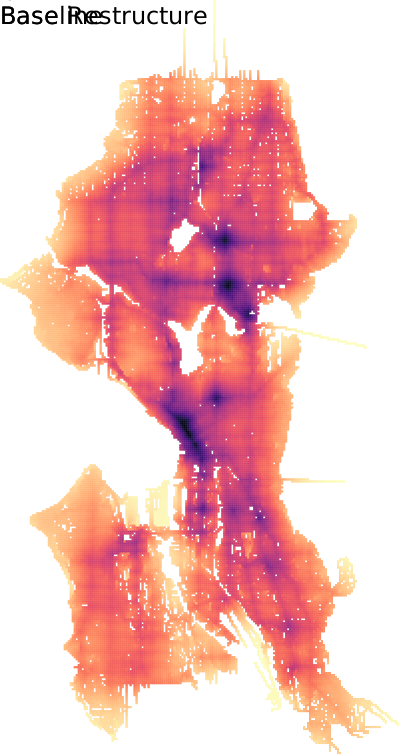
The difference between maps is subtle, but that’s expected given that the access change is not large in the Seattle-wide context. Visible improvement is localized to the Summit neighborhood, and along much of the path of route 11, there is no observable impact. The hope is that reinvesting the service time freed up by the restructure will yield larger access gains that stand out on the map.
Increased Frequency
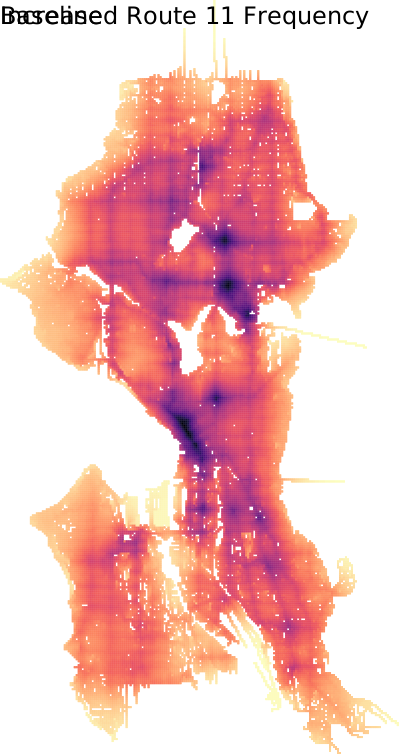
Increasing route 11’s frequency from 20 minute to 15 minute headways between 6 AM and 7 PM gives riders of the route more flexibility during the periods that typically have the highest ridership. Due to the route truncations introduced in the baseline restructure, the frequency increase still yields a network that requires less service investment than today’s network. The access increase over present service of 0.0711% is small overall, but nearly 5 times the increase brought about by the baseline restructure. The map reveals that this increase is driven by a small access uptick along route 11’s path through the Madison Valley.
Making the change involves adding a single directive to the two route 11 trip types.
"ScheduleModifications": [
  {
    "Operation": "HEADWAY",
    "Headway": 900,
    "Start": 21600,
    "End": 68400
  }
]
The Start and End fields are the number of seconds from the beginning of the span of the access calculation. Because this calculation is over a full day, these numbers are the seconds passed midnight that correspond to 6 AM and 7 PM.
Extended to Eastlake
The earliest transit service to the Summit neighborhood was an electric streetcar, the legacy of which persists in the overhead wire that trolleybuses use today. In making service through Summit part of route 11, though, conventional buses must be used, as not every section of route 11 has overhead wire. This allows transit service to the neighborhood to no longer just terminate there, but extend further, putting more destinations within reach. This proposal continues the course of route 11 further west into the Eastlake neighborhood.
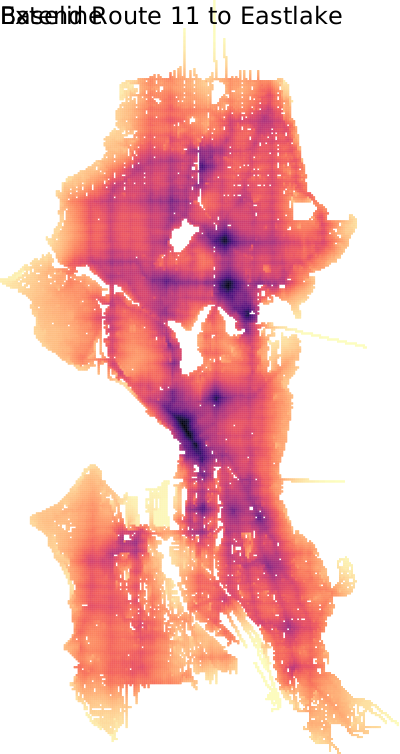
Implementing this extension still requires less in service time than the present network. The access gain is on the same order as the previous proposal, but the benefit is concentrated in different places. The map shows that even without frequent service, an east-west connection, in the form of route 11, is a boon for Eastlake.
Extending the route involves reactivating two stop pairs on Lakeview Boulevard East, and one pair on Boylston Avenue East, that were closed when King County Metro canceled route 25. Historic GTFS files from MobilityDatabase provided the exact locations of the former stops. Adding stops is done using a new ADD directive to the StopModifications list.
"StopModifications": [
  {
    "Operation": "ADD",
    "Stop": {
      "Location": "47.6285172,-122.326767",
      "Name": "Lakeview NB FS Belmont",
      "Id": "Lakeview NB FS Belmont"
    }
  },
...
]
The Id of a stop must be unique, but duplicating Names is allowed.
The time taken to move between stops, whether those stops are new or existing, is specified by the RELATE directives described in the previous post. The new stop ids can then be used as part of EXTEND operations, like this one for route 11 westbound.
{
  "RouteName": "11",
  "TripType": "T2",
  "RoutingModifications": [
    {
      "Operation": "TRUNCATE",
      "Position": 18,
      "End": "ENDING"
    },
    {
      "Operation": "EXTEND",
      "End": "ENDING",
      "StopIds": [
        "13480",
        "13500",
        "13510",
        "Lakeview NB FS Belmont",
        "Lakeview NB FS Boylston",
        "Boylston NB NS Boston",
        "9220"
      ]
    }
  ],
  "ScheduleModifications": []
}
These instructions cause route 11 westbound to deviate from its existing path at the E Olive Way & Summit Ave E stop, serve stops on Summit Avenue East, make its way down Belmont Avenue East to serve a stop just after turning onto Lakeview Boulevard East, continue on that street as it becomes Boylston Avenue East, then use East Lynn Street and Eastlake Avenue East to terminate at an existing route 70 stop, Eastlake Ave E & E Newton St.1 The corresponding eastbound change is similar.
Both Changes
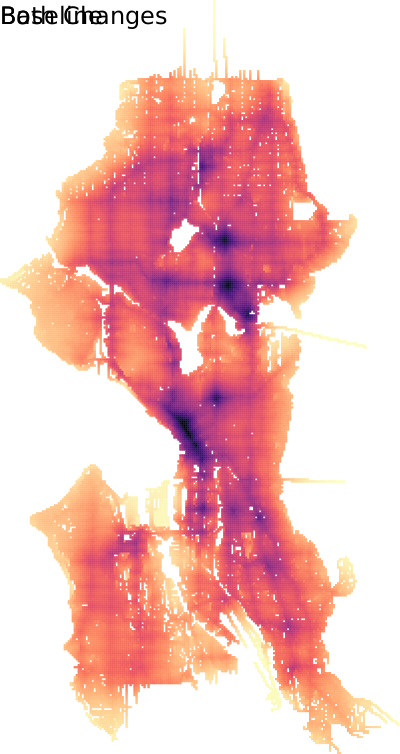
Neither of the two proposals burns through all the in service time freed up by the initial restructure, so implementing both should not be ruled out. Combining them reveals that they are synergistic: together they generate a greater percentage of access gain than the sum of their individual increases. This improvement is easier to see than that of the prior proposals; the map shows visible increases in access over the full path of route 11.
Unfortunately, the transit network that includes both changes uses marginally more in service time than the current network. Because in service time approximates the amount of time a transit operator must be paid, adopting this network could increase Metro’s operational costs. This would make it less likely to actually be implemented.
As mentioned in the previous post, though, more information is required to know for sure. A better approximation would use the time associated with every block, or group of trips run by the same vehicle, since operators are paid during layovers and while repositioning of vehicles while out of service. The GTFS transit schedule format allows for the inclusion of block information, and many agencies provide it; calculating the block time for an existing network is trivial. Once networks are modified, though, arf would need to know how to arrange the modified trips into feasible blocks. Adding this capability to arf—in essence allowing it to go from rough route sketches to fully realistic schedules—has always been a goal, and is next up for implementation.
-
Once the Rapid Ride J stop at East Lynn Street is open, route 11 would serve that stop instead, shortening the route and serving a more central point within Eastlake. ↩︎